Put that watermelon down! Here have, this Banana instead, it has a lower
Glycemic Index...
Not only have I heard such comments from nutritionists and personal trainers
countless times over the years, but I was equally guilty of passing on similar
advice.
In this blog post:
- What happens to carbs when you eat/drink them?
- Does the "type" of carb matter?
- How does your body burn carbs for energy, and does it matter?
- What happens to carbs that you don't "burn" with exercise?
- What are the potential hidden health risks of glucose circulating in your blood?
- Can eating too much carbs affect your cholesterol? Are carbs the real cause of heart and cardiovascular disease?
- Is there such a thing as "too much protein"?
- Are there guidelines for me to chose which carbs to avoid and which I don't have to worry about?
The Glycemic Index (GI) has been around since the early 1980s, and is
calculated from the "rate at which blood glucose rises" in response
to the consumption of a certain food or drink. In other words, a tablespoon of
sugar has a higher GI vs. oatmeal because it causes a more rapid increase in
the amount of glucose in your blood.
But why is that important? What is glucose? Is the GI a good guide to eating
healthy? How strict do I need to be? Are there better means out there to guide
you? What about other carbohydrates?
Slow down with the questions! I'll attempt to tackle them one at a time...
So what is glucose,
why should you care how much of it is in your blood and how quickly it got
there?
Glucose is the simplest molecule of sugar found universally, and the most
easily absorbed and commonly utilized by humans and animals. Most carbohydrates
ingested by human beings get broken down in the digestive tract into glucose,
which gets absorbed through the gut wall into the bloodstream.
Note that there are 2 other monosacharides (or simple sugar molecules) other
than glucose: these are fructose (found in fruits) and galactose (found in some
dairy products). Just like glucose, fructose and galactose are both
"simple" sugars; in other words, they get easily and quickly absorbed
into the blood stream.
Here's another piece of useful info: fruits typically contain 1g of glucose
for every 1g of fructose. In other words, if an apple has 20g of fructose, it
will also have 20g of glucose, resulting in a total of 40g of simple
fast-absorbing carbohydrate molecules.
Let's start with
the sources of glucose in the bloodstream. Later on we'll tackle what happens
to it once its there and why that's important to keep an eye on...
There are 3 primary sources for the glucose circulating in your bloodstream:
1. Digestion of carbohydrates ingested
2. Breakdown of glycogen stores in the liver and muscles
3. Gluconeogenesis: creation of glucose molecules from non-carbohydrate
compounds
1. Digestion of Carbs Ingested
Origins:
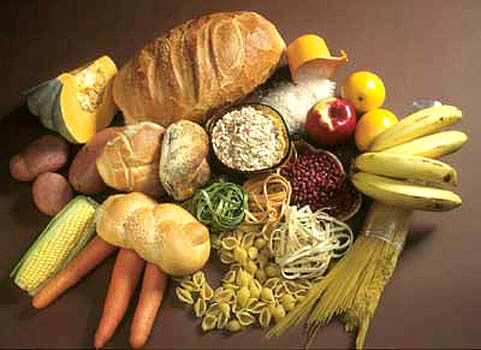
That's a simple one. When you eat any form of
carbohydrate, their breakdown into simple sugars (glucose, fructose, galactose)
starts in the mouth and ends in the intestines. This happens to all forms of
carbs, whether they're complex starch such as oats or potatoes or simple sugars
such as fruits or candy.
Does "all" the carb ingested get broken down in the digestive tract?
The answer is no: some of it (such as insoluble fibers or even very starchy
vegetables) stays in the large intestine, where it acts as food for the
bacteria residing in your colon through a process called fermentation. Another
reason for weak digestion of carbs in the overall health of your gut lining:
inflammation caused by inflammatory components (such as gluten or soy) can
easily disrupt your gut's ability to digest carbohydrates.
Side note: if your colon is predominantly inhabited by bad bacteria, this
results in bloating, gas, and other digestive distress. As a result, one good
way to address such problems is by severely restricting carbs for a few days to
kill off those bad bacteria and then repopulating your colon with good bacteria
by taking a good quality probiotic, or eating good quality fermented foods or
yogurt.
But anyway, if your digestive tract is healthy and most of the carbs you
consume get digested into glucose or other simple sugars, those molecules get
absorbed into your bloodstream.
When does it happen:
Every time you
consume any carbohydrate-containing food or drink.
2. Breakdown of Glycogen Stores in the
Liver and Muscles
You see your liver and muscles have the ability to "store" glucose
for future use. Both of these organs have "barrel-like" structures
that are able to "package" glucose molecules into more complex
molecules called glycogen and save them for future use.
One way of looking at it is as follows: glucose molecules are loose sheets of
A4 paper floating around. The liver and muscles grab those papers and put them
in folders. When a shortage of glucose is detected, a folder is opened and its
A4 sheets are dumped out, releasing glucose in the bloodstream again.
But hold on! This is not a free ride at all: the liver and muscles have a very
small storage capacity, so only a very small fraction of blood glucose actually
gets converted into glycogen for storage in the liver/muscles.
Note: the liver is capable of storing glucose as glycogen and then releasing
that stored glucose into the bloodstream. Muscles on the other hand CANNOT
release glucose from glycogen into the bloodstream: muscle glycogen can ONLY be
utilized by that muscle itself to contract.
Origins:
Glucose from
bloodstream being converted into glycogen. Glycogen being broken down into
glucose when needed.
When does it happen:
When immediate need for glucose arises and enough glycogen stores are available
in the liver (for general use) and muscles (for local use only).
3. Gluconeogenesis
Gluco (glucose) - neo (new) - genesis (generation) is a chemical process
whereby glucose molecules are formed from non-carbohydrate compounds.
Gluconeogenesis occurs when there is an extreme shortage of glucose: in other
words, when there is no glucose from digested carbohydrates and glycogen stores
in the liver and/or muscles are depleted.
Origins:
90% of gluconeogenesis comes from 3 compounds: (i) lactate, (ii) glycerol, and
(iii) certain amino acids.
I won't get into the chemical processes for gluconeogenesis from each of these
3 compounds, but I'll explain what they are:
(i) Lactate: it's a bi-product of energy
production in muscles. You may have heard of lactic acid, technically that term
is not correct. Muscles produce lactate and Hydrogen atoms, which are then
recycled through gluconeogenesis to produce energy. When the rate of recycling
can't keep up with the amount of lactate being produced, your muscles
accumulate those Hyrdogen molecules and become more and more acidic and
eventually shut down.
(ii) Glycerol: is what is typically bound to a fatty
acid to form Triglycerides, the main culprit behind cardiovascular disease. So
a shortage of glucose can cause Triglycerides to breakdown into glycerol (used
for gluconeogenesis) and free fatty acids (which have many healthy uses in the
body).
(iii) Amino acids: in extreme glucose shortages, the
body is able to breakdown amino acids (the building blocks of protein) and use
them for glucose production. This is why it is not advisable to exercise
intensely for long periods of time without adequate carbohydrate intake: your
body will "eat itself" to generate glucose.
When does it happen:
Extreme situations when no glucose is available from digestion and glycogen
stores are depleted.
So what happens to
glucose when it hits your bloodstream?
Let's put the second (stored glycogen) and third (gluconeogenesis) sources of
blood glucose on the side for a moment: they only occur when glucose is in
short supply and is "immediately needed for quick utilization". So
technically, you cannot have circulating blood glucose in these situations as
it's immediately utilized.
In other words, glucose in the blood from glycogen or gluconeogenesis is
"demand-driven": if it's not needed somewhere in the body, it won't
even be there.
Glucose from food/drink on the other hand is "supply-driven": if it's
consumed and digested, it will enter the bloodstream, whether you need it or
not. And "that", my friends, is where you should pay attention!
What happens to that blood glucose then?
1. Energy production
2. Glycogen Storage
3. Fat storage
4. Glycation
1. Energy Production
There are 3 main ways for your cells to produce energy, ranked by order of how
quickly they can produce energy:
a- The fastest (creatine phosphate pathway) does not use glucose or fat, and
will only give you power for 10-second efforts (e.g. sprinting hard)
b- Glycolysis: breakdown of glucose to be utilized for any effort beyond
10-seconds
c- Beta-oxidation: utilization of fatty acids
Your brain, muscles, heart, and other organs are equipped to produce energy
using glucose - so if any of them has a need for glucose and glucose is
available in the bloodstream, it will be utilized.
Practical Applications: let's say you're undertaking a very hard AND long
effort - in this particular situation:
- Long effort means the creatine phosphate pathway isn't enough since it only
provides 10-seconds of effort
- Hard effort means beta-oxidation doesn't work because you need energy
quickly, and breaking down fatty acids takes a bit of time
- Glucose is the only fuel that works, and comes from a combination of stored
glucose (glycogen) and glucose from a sports drink for example. If you don't
ingest food/drink that can be converted to glucose quickly, your glycogen
stores will get depleted, and once empty (after 90-120min), you experience what
many athletes have experienced and fear: the Bonk!
So what happens if you don't "need" that glucose to produce energy?
2. Glycogen Storage
When your body detects glucose in the
bloodstream and doesn't need it for energy production, then its first action is
to remove it from the bloodstream and "store" it in the form of
glycogen in the liver and muscles.
The hormone "Insulin" (released by your pancreas) travels to your liver
and muscles and instructs them to remove glucose and store it in the form of
glycogen.
Practical
Applications: while the body has limited glycogen storage capacity, there are
still ways to increase that capacity (to a certain limit!). Frequent
"emptying" and "refilling" of glycogen stores will trigger
an increase in storage capacity - in other words, your liver/muscles will
create more "folders" in which to store floating A4 paper.
So, what kind of exercise can lead to that? Any unfueled effort lasting
45-90min at an intensity that's hard enough to deplete glycogen. Examples
include: interval training, tempo runs, crossfit, circuits, etc. (more on that and other sports-related info in Part III).
Again though, to a certain limit! Yes this means you can get away with eating a
little more carbs and feel comfortable that it's getting stored as glycogen and
not fat, but that capacity remains very limited no matter how hard your
train...
So what happens when glucose is not needed for energy and glycogen stores are
full? You guessed it! It gets converted to fat.
3. Fat Storage
So you ate that banana before going to bed, you didn't exercise hard before
doing so, so your glycogen stores are full. The starch in that banana gets
broken down into simple sugars: glucose and fructose and enters your
bloodstream.
Your pancreas detects that glucose and secretes insulin, sending a Group BBM
message to your liver and muscles and get that glucose out of the blood ASAP!
But here's the problem: your muscle glycogen stores are full, so they can't
take any more glucose. Your liver's glycogen stores are full too! But the liver
doesn't give up so easily: it does remove that glucose, but by converting it
into fatty acids and releasing those fatty acids into your bloodstream in the
form of Triglycerides!
And those triglycerides start accumulating and form "adipose tissue",
aka fat storage under your skin.
Ok so does this mean it's impossible to have glucose in your blood except after
a meal? Since glucose will either be used, stored as glycogen or stored as fat,
there shouldn't be any left in your blood a few hours after a meal, correct?
Well no, not exactly...
4. Glycation
... and how sugar is what causes cardiovascular disease, not fat...
Let's revisit something we talked about earlier: every time a simple sugar
(glucose, fructose, galactose) enters your bloodstream through your digestive
tract, your pancreas will start churning out Insulin - this hormone acts as a
messenger to your liver and muscles to remove that sugar by either storing it
as glycogen or converting it to fat.
BUT there are 2 exceptions to that rule:
(i) Insulin resistance: if you keep eating foods
that cause your Insulin to spike, your liver and muscles become "less
responsive".
It's like an "enough already!" attitude by your
liver and muscles. As this resistance develops, less and less glucose is
removed from your blood, so it sits there circulating and reacting with other
components in your blood (more on that later).

ii) Pancreatic fatigue: when this Insulin Resistance develops, your pancreas
has no idea what's going on. It does NOT know that its messengers (Insulin) are
being ignored. So what does it do? Send more messengers!
In other words:
Glucose enters blood from digestive tract => pancreas
secretes insulin => insulin is ignored by liver and muscles => pancreas
secretes "even more" insulin => pancreas gets fatigued and
ultimately lowers insulin production => TYPE II DIABETES
Of course, you are at an even higher risk of developing that form of
diabetes if you have a family history of this disorder, as you are likely to
develop insulin resistance at a faster rate.
Furthermore, if left untreated, the fatigue in the pancreas can become so
extreme that insulin production gets almost completely shut down. You reach a
point (Type I Diabetes) where the only solution is to get insulin injections,
in most cases for life...
SO! Now you have free simple sugars floating around in your bloodstream and
it's not being picked up by your liver and muscles - what do they do?
They cause something called "Glycation". Glycation occurs when a
simple sugars bind to either a protein or a fat molecule, causing a range of
oxidative damages.
What happens is: when a sugar molecule
is bound to a protein molecule, the resulting "glycated" molecule is
highly damaging to anything it comes in contact with in the body. Some of the
common disorders which have been linked to glycation of proteins through
countless studies over the past 10 years include:
- Degeneration in nerves (particularly associated with Alzheimer's Disease and
deafness)
- Cardiovascular disease
- Cancer
Of particular importance is when cholesterol molecules get glycated by simple
sugar molecules: Low Density Lipoproteins (aka LDL, also inaccurately referred
to as "bad cholesterol") attach to simple sugar molecules and become
glycated. Once this happens, risk of oxidation for these LDL molecules is
drastically multiplied.
Then these "oxidized LDL" molecules travel through the arteries and
cause inflammation in the arterial cell wall, leading to the formation of
"plaque". Triglycerides floating around are then able to attach
themselves to the inflamed arterial walls.
Numerous studies have shown that non-oxidized LDL does not cause plaque to
build up in the arteries, but rather "oxidized LDL" does; and the
oxidation of LDL does not occur without the presence of simple sugar molecules
in the blood-stream. This also forms the foundation of the linkages between
diabetes and cardio-vascular disease:
Diabetes => high blood sugar => glycation of LDL
=> oxidized LDL => inflammation in arterial cell wall => plaque
formation
BUT HOLD ON! There is another BIG problem we omitted to mention:
I said that when LDL molecules are oxidized, plaque forms in the arteries and
triglycerides contribute to that problem. So does a "low fat" diet
that minimizes LDL and triglycerides in the blood take care of that problem?
Well no, it doesn't, and here's why:
1. Insulin spikes from carbohydrate food/drink
"switch off" an enzyme called "Lipase"
2. Lipase (as the name implies) is responsible for breaking down lipids
(triglycerides/fats) into free fatty acids to allow the body to use them as
fuel for energy
3. With a high carb / low fat diet, insulin is high, lipase is low, and fat
molecules not being used for energy start accumulating, whether you like it or
not, and float around in your blood waiting to be "glycated" and
oxidized.
In addition, the "excess glucose" gets converted to
triglycerides and those are added to the existing ones in the bloodstream as
well. In other words, even a ZERO fat high carb diet will lead to
triglycerides, high LDL, oxidized LDL, plaques and cardiovascular disease.
All this science is great, but how do
I apply that to real life???
Let's try to simply it a bit... If you've read all of what I discussed so far,
you know that:
1. Insulin spikes are caused by the amount
and type of carbohydrates we eat
2. Insulin spikes cause insulin resistance
and pancreatic fatigue, eventually leading to Type II Diabetes
3. This causes high concentrations of
sugar molecules in the blood
4. A significant portion of that sugar is
converted to triglycerides (fat), attached to LDL
5. Those sugar molecules
"glycate" proteins and fat, thereby creating corrosive substances
inside your body
6. Glycated LDL molecules get oxidized,
cause inflammation in the arteries, leading to plaque formation and
cardiovascular disease
SO, if you work backwards: to stop (6)
from occurring, you need to limit (1) from happening: in other words,
your aim should be to minimize Insulin spikes.
What types of food
cause insulin spikes - the whole Glycemic Index concept
Simply put, all foods and drinks containing any form of carbohydrate will cause
some sort of insulin reaction.
Side note: proteins also cause insulin reactions, a little know fact. Amino
acids can also be converted to fatty acids & triglycerides. So yes, too
much protein DOES make you fat.
But as you probably already know, some carbohydrates cause a more significant
insulin reaction than others. For instance, you would expect table sugar to
cause a bigger insulin spike compared to, say, a potato for example.
Historically, the nutrition and diet industry relied on the concept of Glycemic
Index (GI) to differentiate among various foods and drinks when it came to
insulin impact.
The concept of the GI is simple: Glucose is giving a score of 100. Any item
which causes a bigger insulin spike than glucose has a score of more than 100.
Anything that causes a lower insulin spike gets a score under 100.
For example: a Mars bar has a GI score of 78, while apples have an average
score of 50.
Generally, a score of 55 or less is considered LOW, 56-69 MEDIUM,
and 70 or higher HIGH.
But the GI concept is far from perfect: it has fallen to increasing criticism by healthcare practitioners in recent years for a wide variety of reasons,
including the fact that it does not take "portion size" into account...
Take wholewheat bread for example: it carries a GI score of 97! That's almost
as high as pure Glucose, and even higher than that Mars bar! In fact, it
carries a higher GI score than White Bread (71)! How can that be?
Well portion size is a big factor there: you see wholewheat bread is far less
dense (weight/volume) when compared to a glucose, a Mars bar or even white
bread.
The Concept of
Glycemic Load
Enter the concept of Glycemic Load (GL): the GL concept was created to address the
portion size issue when dealing with GI - it gives foods a score based on a
combination of GI and typical portion size. In other words, it measure the
impact on your blood glucose of consuming a typical serving of a certain food.
Generally, a score of 10 or less is considered LOW, 11-19 MEDIUM,
and 20 or higher HIGH.
Let's pick up that example we used earlier:
A typical Mars bar weighs around 60g and has a GI of 79.
A typical slide of wholewheat bread weight around 45g and a GI of 97.
BUT: the Mars bar would have a GL of 27 (HIGH), while the slide of wholewheat
bread would be at 7 to 10 (LOW).
The Concept of
Insulin Index
The Glycemic Load is a convenient way of looking at things, but again, it's not
ideal. The GI/GL concepts measure the impact food has on the amount of glucose
circulating in your blood, but as we discussed at the beginning of this post,
the story doesn't end there:
- Your body has a mechanism to deal with glucose entering your blood: insulin
is secreted, sending a message to your liver and muscles to remove that glucose
and either convert it to glycogen or fat
- So the "insulin response' matters much more than the "blood
glucose' after eating
- The insulin response can vary from person to person
- As we discussed earlier, some people can develop insulin resistance, or a
"fatigued pancreas" may not be able to produce enough insulin in the
first place...
==> so is there a way to measure the "insulin response" created by
various foods?
As a matter of fact, there is, and it's called the Insulin Index (II).
By
measuring the insulin response of food/drink, it already presents a significant
advantage over the GI/GL concept. Furthermore, I noted earlier that even
proteins can cause an insulin response, and the II captures that as well. Also,
while the GI is calculated using Glucose as a baseline (score of 100), the II
uses white bread as its baseline, with an II score of 100.
Let's take some examples:
- White bread: 100
- Wholewheat bread: 96 (yes, it's nowhere near as healthy as you think!)
- Mars bar: 122
- Potatoes: 121
- Banana: 81
- Apple: 59
- Cornflakes: 75
- Baked Beans: 120
- Cheese: 45
- Beef: 51
- Fish: 59
The high scores for high GI foods (white bread, potatoes) are certainly not
surprising. It is somewhat surprising that "healthy and lean
proteins" also cause such an insulin response... But don't be alarmed: if
you're eating sensible amounts of protein, that insulin response is actually
quite beneficial: the rise in insulin caused by a moderate amount of protein
actually drives the amino acids from that protein into your muscles to build
new muscles fibers, which is always a good thing!
You will find a table with the Insulin Index for common foods here.
Summary
So to recap, in Part I of this post, we talked about:
1.
What happens to carbohydrates once you
consume them.
2.
How your body reacts to those
carbohydrates, and what happens to the glucose once its enters your
bloodstream.
3.
How too much carbohydrate consumption
can have adverse effects on your health, including fat accumulation,
inflammation, and cardiovascular disease.
4.
How different foods can cause different
insulin reactions, and therefore can have different effects on your health,
performance and well-being.
In Part II (coming over the next 2 weeks), we will cover:
1. What are the general benefits of limiting carbs
2. How carbs impact the health of your digestive system
3. What causes sugar cravings and how to deal with them
4. A bit of history on our diet, and the evolution of carb content vs. protein and fight (yes, I will be picking a fight with the food pyramid!)
And in Part III (I promise not to keep you waiting!), we will cover:
1. Eating recommendations for general health
2. Eating recommendations for athletic performance
3. How "strict" do you need to be in your eating habits
4. How you can still enjoy your love for food without risking your long-term health
As always, feel free to ask any questions in the
comments section below and I'll be happy to answer them.


